Sunday, 29 March 2015

Pyracantha coccinea - Firethorn


Pyracantha coccinea - Firethorn


Location: Chorlton, Manchester. P. coccinea is a medium sized evergreen shrub that can reach heights of up to 4m. It is planted for it's striking colourful fruits that appear in Autumn/ Winter, another reason why it would be planted is that it makes a good hedge plant (topiary is practiced on it) and can keep animals and people away because of it's defensive thorns. It is generally disease and pest free, this specimen is in prime condition.


The scarlet fruit that grows in bunches is a seasonal interest for animals (for food) and people.


The leaves are dark and shiny with fine serrated edges.
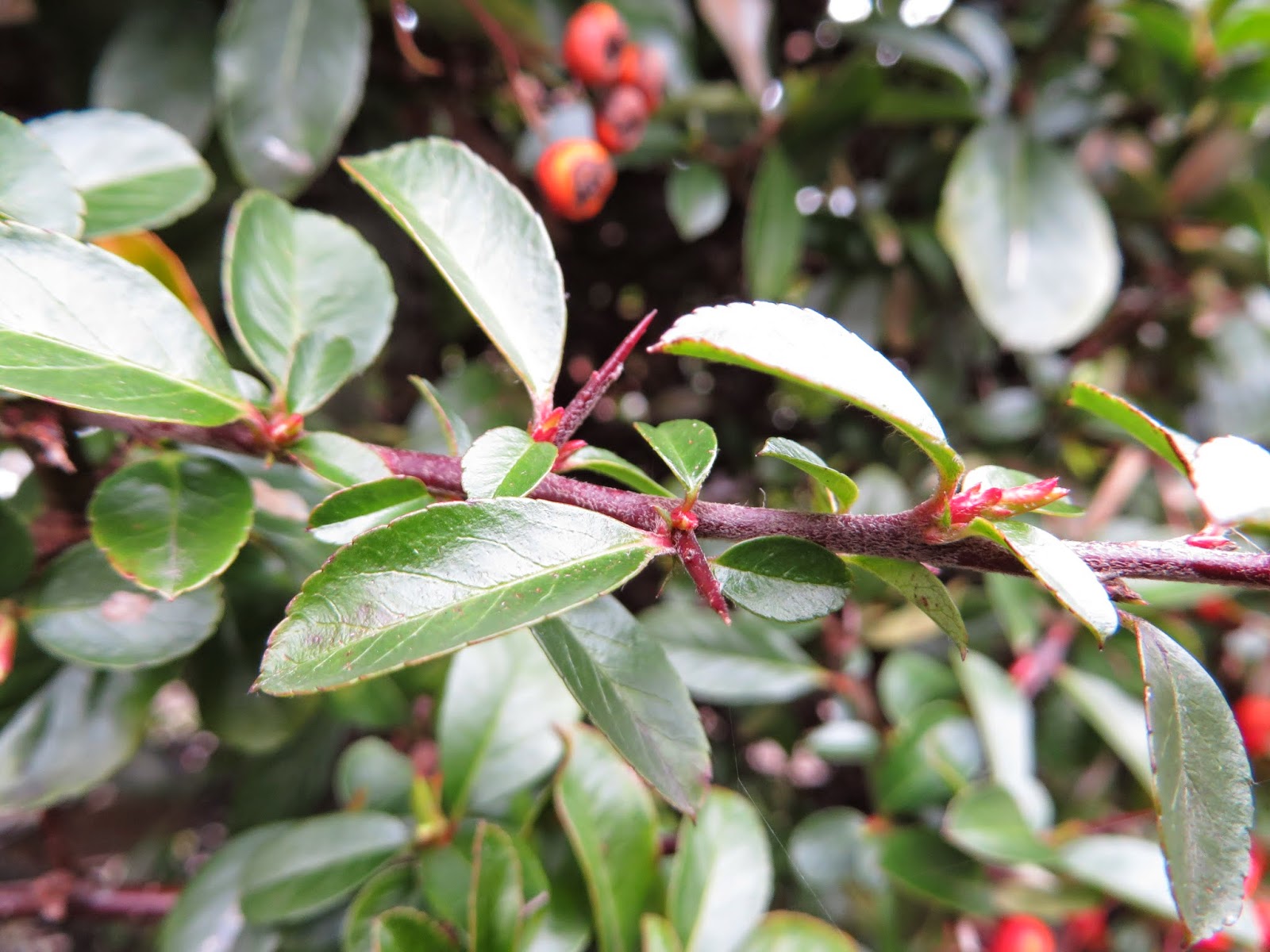

The plant shoots long narrow stems in all direction that are riddled with thorns hidden in the foliage.

Friday, 27 March 2015

Garrya elliptica - Silk tassel bush


Garrya elliptica - Silk tassel bush


Location: Dunham Massey National Trust/ Manchester. G. elliptica is an evergreen shrub that can reach  a height and spread of 3-4m. It favours to grow in full sun/partial shade and in well drained soils.


It's flowers are produced in late Winter/ early Spring in the form of long white pendulous catkins (up to 20cm in length).


They are made up of many individual white flowers with brown stems and fine silvery-silky hairs.


The leaves are dark green, hard and leathery. They are oval shaped and have wavy margins. This specimen is suffering from leaf spot disease it is a pathogen that is only showing symptoms in the leaves.


The bark is rough, grey and riddled with pores.


A younger stem has a dark clay colour.

Saturday, 21 March 2015

Hamamelis mollis - Witch hazel


Hamamelis mollis - Witch hazel


Location: Dunham Massey National Trust. H. mollis is a deciduous shrub that is planted for its ornamental features and for its fragrant flowers. They can reach heights of 4m and can take 10-20 years to get there, this specimen is around 2m tall so its already halfway through its ultimate growth capacity. It prefers to grow in full sunlight and moist-well drained soils. Around it are ornamental grasses, tulips and daffodils in the background.


The flowers that appear in late Winter are frost resistant and produce an irregular crown of yellow-paper like strips for petals.


The bark appears grey, this specimen has moss growing around it thats giving the distinctive green colour.


The leaves are ovulate with a point at the tip and are serrated on the margins. They have small hairs on the underside.


An emerging leaf showing it's hairs and another earlier emerged leaf behind it.

Wednesday, 18 March 2015

Hebbe spp.


Hebe spp.


Location: Longford Park, Manchester. Hebe is a genus of dense evergreen shrubs with simple paired leaves that grow opposite each other and create remarkable geometric patterns this way. They are commonly used as boundary defining plants and are generally disease and pest free which is another reason why it's often used in urban areas such as roads, car parks and public walkways.


This species is called Hebe rakaiensis commonly known as 'Rakai hebe'. It's dense growth give it a bushy characteristic.


The leaf bud is shown at the top of the main shoot ready to split into two leaves, a lateral shoot can be seen growing out of the main one to helping create the dense bush.


The stems narrow, dark brown and bumpy.

Saturday, 14 March 2015

Pittosporum tenuifolium - Kohuhu


Pittosporum tenuifolium - Kohuhu


Location: South Norwood/London. P. tenuifolium is an evergreen shrub native to New Zealand. It can grow up to heights of 4-8 meters. It is growing in sandy soils that isn't moist enough for it's preferences also it needs a much more sunny location to excel in. Despite these negatives it is growing healthily for now.


The only way to recognise the plant species all year round is by its shiny evergreen leaves, they are rounded with distinctive wavy margins.


In the spring it will produce clusters of small dark purple flowers.


Flower buds that are ready to bloom in Spring.

Wednesday, 11 March 2015

Helleborus orientalis - Hellebore


Helleborus orientalis - Hellebore


Hellebore, otherwise know as Christmas rose is a herbaceous perennial that blooms in late winter. This specimen is located in Longford Park, Manchester growing in drained soil next to a dryopteris filix-mas. It suffers from cold harsh winds in the winter and protection is what the fagus sylvatica hedge gave that can be seen in the background. Helleborus prefers to grow in full shade or partial shade however this specimen is exposed to sunlight.


H. orientalis is an evergreen herbaceous perennial. It's leaves come in many shapes and sizes here we can see a few growing in a cluster of serrated ovulate leaves.


Lower down the stent the leaves are palmate and lobed.


At the base of the plant the leaves are palmate dark green and at their largest.


The flower is usually cup shaped and downward pointing, it is made up of five petals that are often found with inside spotting. At the centre is a crown of yellow stamens.


Helleborus can be found in a variety of colours from white to pink to purple.

Saturday, 7 March 2015

x Cupressocyparis leylandii - Leyland cypress


x Cupressocyparis leylandii - Leyland cypress


Location: Longford Park - Manchester. The leyland cypress is in fact a hybrid between two genera, Cupressus and Chamaecyparis. Its a rapidly growing tree that can reach heights of 35 meters. When left to grow naturally, it's overall shape looks like that of a giant flame.
It is a common hedgerow tree species used mainly as a shelter belt to buffer sound, sunlight, wind etc.


Upright columnar growth. The group of specimens are in good health and are growing fine where they are.


Scale-like foliage. Leyland cypress trees are hermaphrodite and produce both male and female flowers that appear on the tips of the shoots.


Because of the tree's naturally thick bushy form it makes for a good specimen for topiary, only the bottom of these cypress' have been shaped to allow access in between the trees.


A shot showing the trees internal structure, it looks similar to a Populus nigra var. italica's structure. It has lost its foliage on this side because it isn't getting enough sunlight so it had no need to grow there anymore.